Curriculum Vitae
I believe a career is built on meaningful impact rather than a long list of publications and metrics. This CV tells the story of my journey, my skills, and my purpose as a researcher.
Bio
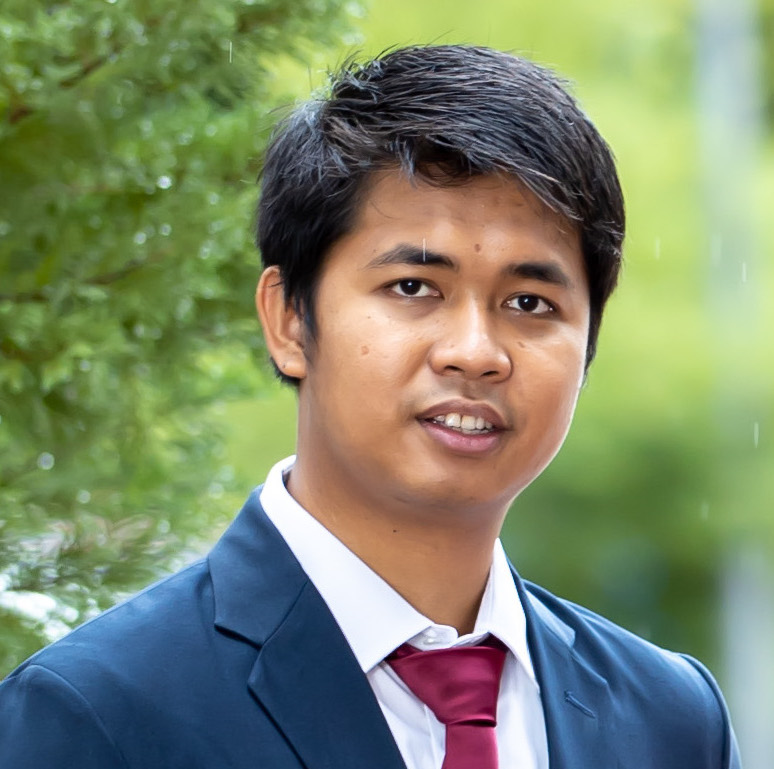
Dr. Ahmad Jafar Arifi earned his Ph.D. in physics from Osaka University, Japan, in 2020, and his Bachelor’s degree from Universitas Indonesia in 2015. During his doctoral studies, he completed a six-month internship at the Japan Atomic Energy Agency (JAEA), gaining valuable exposure to experimental research environments. He then joined the Asia Pacific Center for Theoretical Physics (APCTP), South Korea, as a Young Scientist Training (YST) Fellow, and later worked at RIKEN, Japan, as a Special Postdoctoral Researcher (SPDR). Currently, he is a researcher at the Advanced Science Research Center (ASRC), JAEA. His research focuses on hadron spectroscopy, reactions, and structure, as well as hadrons in medium, employing various data-driven hadronic models and approaches.
Purpose
My purpose is to foster the growth of hadron physics communities in the Southeast Asian region. In physics, my primary objective is to build a broad understanding of hadron physics from multiple perspectives. Specifically, I aim to develop various quark models that explain the diverse properties of hadrons and nuclei, ultimately connecting this knowledge to QCD. To achieve this, I am dedicated to collaborating with new researchers and exploring different methods.
Education
I graduated from leading universities in Indonesia and Japan, where I developed a strong foundation in theoretical physics.
- Ph.D, Osaka University, Japan, Sept 2020
Thesis: Study of heavy baryons from three-body decays
Advisor: Prof. Atsushi Hosaka - M.Sc, Osaka University, Japan, Sept 2017
Thesis: Pion emission decay of the charmed baryons for the study of their structure
Advisor: Prof. Atsushi Hosaka - B.Sc, University of Indonesia, Indonesia, Aug 2015
Thesis: Spin-3/2 nucleon resonances in kaon photoproduction
Advisor: Prof. Terry Mart
Work experiences
I have gained research experience in Japan and South Korea, with the freedom to pursue my interests, collaborate widely, and broaden my scientific perspective.
- Advanced Science Research Center (ASRC), JAEA, Japan
Apr 2025 - Present : Postdoctoral Reseracher (Tenure Track) - Few-body Systems in Physics Lab, RIKEN, Japan
Apr 2023 - Mar 2025 : Special Postdoctoral Researcher (SPDR) - Asia Pacific Center for Theoretical Physics (APCTP), South Korea
Mar 2021 - Feb 2023 : Young Scientist Training (YST) Fellow - Research Center for Nuclear Physics (RCNP), Japan
Oct 2020 - Feb 2021: Research Associate - Japan Atomic Energy Agency (JAEA), Japan
Oct 2019 - Mar 2020: Intern
Publications
See: My publications
- I have published articles about hadrons mainly in Physical Review D
- I have worked with many different co-authors and several students
Presentations
See: My talks
- I actively participate in many workshops and conferences
- I have been invited to several international workshops
- I have attended numerous JPS and KPS meetings
- I have joined many SNP (Strangenss Nuclear Physics) schools
- I have also given seminars at various institutes
Research grants
My research has been supported by various scholarships and grants, motivating me to make meaningful and useful contributions to science and society.
- KAKENHI Early-Career Scientists (Wakate), 2026-2029
- RCNP Core-net, 2025-2027
- APCTP program category 2, 2026
- RIKEN SPDR research grant, 2023-2026
See: My grants
Awards
I am grateful to have received several awards recognizing my technical expertise in physics, presentation skills, and achievements in scientific research.
- The 2nd best contributor, APFB2020 conference, Japan, 2021 (APFB-ANPhA prize)
- The best presenter, SNP school, Japan, 2018 (SNP-ANPhA prize)
- Gold Medalist, National Physics Olympiad, Indonesia, 2014
Community service
Beyond publishing research, I try to contribute to peer review and promote science whenever my time allows.
- Journal referee — Reviewing manuscripts for scientific journals (Physical Review D).
- Conference proceedings referee — Reviewing manuscripts for conference proceedings (ICTAP 2021).
- Special issue editor — Serving as an editor for a journal special issue (SEA-NHP 2025).
- Personal blog hadronid.github.io — Sharing topics on hadron physics and academic life.
Student mentorships
I enjoy mentoring students and believe that every student is different. I encourage them to learn by themselves first, while offering help when needed.
- Co-supervising a couple of students from Indonesia and Thailand.
- Giving a career talk in International physics course (IPC) program 2025, Osaka University.
- Hosting a summer intern for a few weeks at Japan atomic energy agency.
See: Mentorships
Leadership & activities
I see leadership and scientific activities as opportunities to give back, strengthen the community, and help it grow by bringing people together.
- Chair, International Workshop on Quark Structure of Hadron,
RIKEN, Japan, Aug 2024 (Indico) - Supervisor, The 1st Indonesian Student Association Scientific Conference (ISASC),
Osaka university, Japan, Oct 2017 (Abstract book) - President, Indonesian student association in Osaka & Nara, 2016-2017
Responsible for the activities of the association for one year. (Report)
See: My activities
Academic societies
I value being part of and contributing to the scientific community.
- The Physical Society of Japan
- The Korean Physical Society
- Physical Society of Indonesia
Programming skills
I mainly use Julia and Python for numerical calculations and visualization, with additional experience in Mathematica and Fortran.
- Julia
- Python
- Mathematica
- Fortran
Languages
I am eager to learn new languages, particularly those spoken in the country where I live, to deepen my understanding of the local culture and community.
- Indonesian (Native)
- English (Fluent)
- Japanese (Advanced level)
- Korean (Conversational)
Licenses
I hold several licenses and qualifications that support my professional activities.
- Japanese Driver’s License, 2025
- Japanese language proficiency test (JLPT), N2, 2024
- Korean language proficiency test (TOPIK I), level 2, 2022
Others
- Slow Science movement (signed, 2026)
- Katsuta Marathon 10 km finisher, 2026